
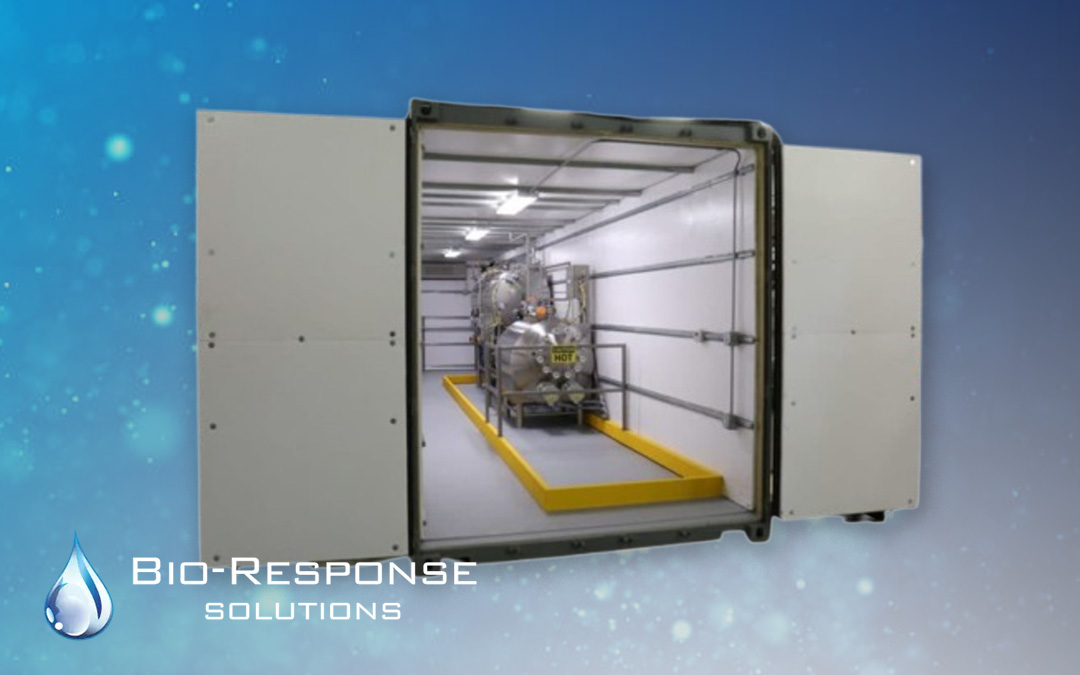
An Effluent Decontamination System (EDS), or biokill system, is a carefully designed system that sterilises and neutralises liquid waste from facilities dealing with potentially contaminated effluents. Thermal Batch is the most common type of EDS, meeting the 121°C standard (250°F), with custom temperatures available. It is available with or without significant agitation and solids handling and can be built from duplex or super-austenitic grade stainless steels for extreme corrosion resistance. Many configurations and standard designs are available to decrease engineering costs, with redundancy options also offered.
Approximately the same cost as a thermal batch system, Thermal Continuous Flow systems involve no pressure vessel or associated risks and operates on just 5% of the energy required by a Thermal Batch system, making it the gold standard for Thermal EDS efficiency. They allow for energy recovery and can achieve very high treatment temperatures (up to 150°C/302°F), with cooling by regeneration often eliminating the need for cold water, tower water, or chilled water. They can be designed to work in the presence of some solids and is available in steam or electrically heated models. They can be built from duplex or super-austenitic grade stainless steels for extreme corrosion resistance, with many configurations available, ranging from 4LPM to 250LPM (1-66 gpm) capacities. Standard designs are available to decrease engineering costs, with redundancy options also offered.
Common configurations include non-redundant setups, featuring two process tanks with the lowest ceiling height requirement, and a piggyback orientation, for the smallest footprint. For redundant configurations, three or more process tanks can be used. For more information on configuration, desired biosafety level and processing parameters, learn more about BIO-RESPONSE SOLUTIONS Thermal Batch & Thermal Continuous Flow systems here or contact Capella Science on (02) 9575 7512 or sales@capellascience.com.aut.
Recent Comments